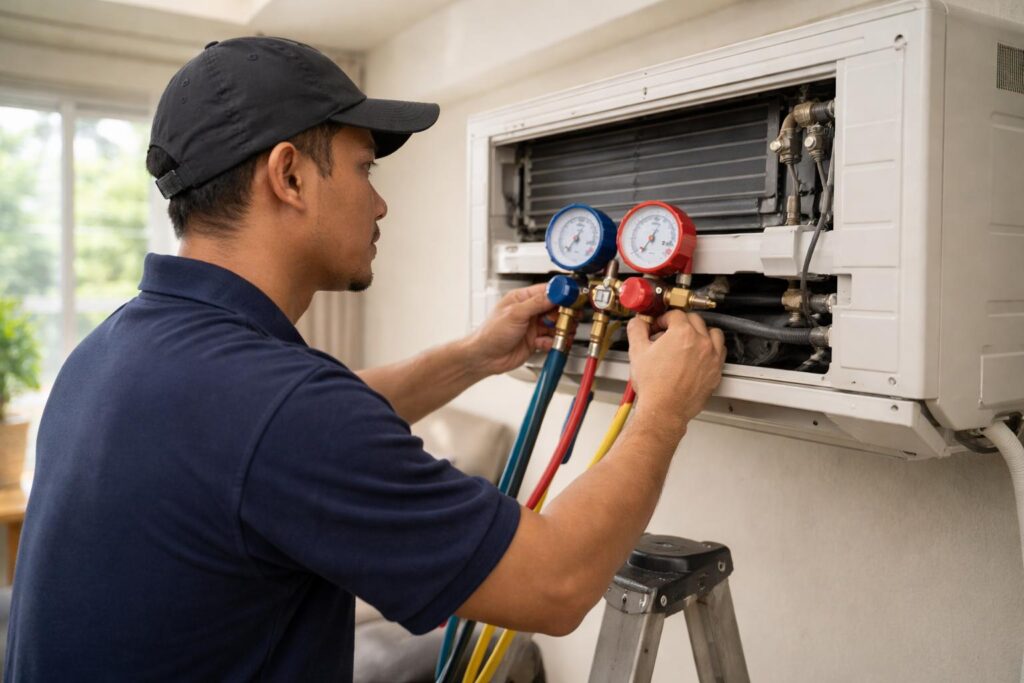
Your air conditioner is a sealed system. It does not use up refrigerant the way a car uses gas, and it should not need more added year after year. So if a technician tells you the charge is low, there is only one honest explanation: refrigerant escaped somewhere.
The Air Feels Warm and the System Runs Longer
The first sign is usually performance, not a puddle. So Tex Indoor Air Comfort spots these signs early during AC repair in San Antonio, before a leak kills a compressor. Rooms take longer to cool, the system runs for long stretches without reaching the thermostat setting, or a heat pump struggles on a mild fall day when it should have no trouble. Low refrigerant means the coil cannot absorb and move heat the way it was designed to.
Hissing, Bubbling, and Oily Residue
Refrigerant leaks often leave physical clues. A hissing sound near the indoor coil or outdoor unit can mean refrigerant escaping under pressure from a small crack. Look for oily residue around fittings, service valves, and the copper lines — refrigerant oil travels with the refrigerant, so an oily stain is often exactly where the leak is.
Ice on the Lines or Coil Is a Red Flag
Ice seems backward for an air conditioner, but low refrigerant drops pressure and temperature in the coil until moisture freezes on it. You may see frost on the copper suction line, ice on the outdoor unit’s connections, or a frozen indoor coil that melts and drips water where it should not. Turn the system off and let the ice melt before anyone checks the charge — readings on a frozen coil are not accurate, and running a system low on refrigerant can overheat and damage the compressor, the most expensive part in the system.
Why a Top-Off Alone Wastes Money
Adding refrigerant without finding the leak is paying for the same repair twice — or three times. The new charge will leak out at the same rate, performance will fade again, and the system will work harder, wear faster, and risk compressor damage. A proper repair follows a clear order: find the leak, repair or replace the failed part, pressure-test, pull a deep vacuum, then weigh in the correct charge listed on the nameplate. Anything shorter is a guess.
When to Call for Help
Call for AC repair in San Antonio if you notice warm air, longer run times, hissing or bubbling, oily spots on lines or fittings, ice building up, or a system that needed refrigerant last season and is low again. Those are a pattern, and patterns point to a leak. If repair no longer makes sense, we give one flat-rate total for system installation in San Antonio before work begins.
So Tex Indoor Air Comfort provides honest HVAC service in San Antonio and the surrounding area, with same-day service during business hours when available. Call (210) 306-4205 to schedule a leak check today. TX HVAC license #TACLB78723E.


Leave a Reply