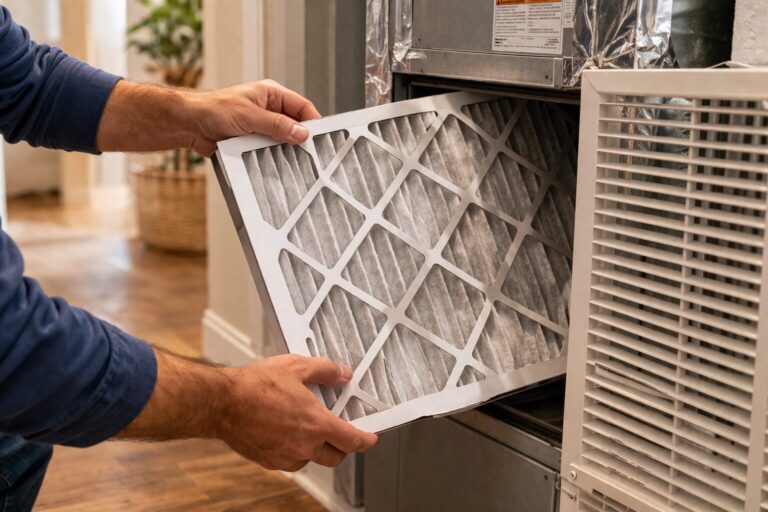
If your eyes start itching in December and your sinuses feel worse indoors than out, you already know cedar fever. Hill Country mountain cedar — Ashe juniper — releases its pollen from late December through February, and mid to late January is usually the worst. Your heating system runs that pollen through your house all winter, and the thin 1-inch filter in most return grilles was never built to stop it.
Cedar Season Starts Earlier Than Most People Think
Cedar pollen does not wait for a hard freeze. The first cold fronts in November and December shake pollen loose, and on windy days it travels for miles across San Antonio. Once it gets inside — on clothes, through open doors, and through leaky ductwork — your blower recirculates it every time the heater runs. That is why symptoms often flare up at night, when the system has been cycling for hours.
Why a Thin 1-Inch Filter Falls Behind
A standard 1-inch filter is mostly there to protect the equipment, not your lungs. It catches lint and large dust, but fine pollen passes right through its thin mesh. Worse, it loads up fast. During cedar season a 1-inch filter can clog in a few weeks, and a clogged filter chokes airflow, makes rooms heat unevenly, and forces longer run times. Check it monthly from December through February, and change it the moment it looks gray and matted.
A Real Media Filter Catches More — Without Starving Airflow
A deep media filter cabinet uses a 4- to 5-inch pleated filter with far more surface area. A higher-efficiency filter, typically MERV 11 to 13, traps much more pollen while still letting air move freely, and lasts months instead of weeks. A dense 1-inch filter, by contrast, can restrict airflow and strain the blower — the media cabinet avoids that trade-off. This is why So Tex Indoor Air Comfort includes an installed media filter on every regular system installation San Antonio homeowners buy from us. In cedar country, it is part of doing the job right.
Leaky Ducts and Humidity Make It Worse
Filtration only works on air that actually passes through the filter. Leaky return ducts in a dusty attic pull unfiltered air — and whatever floats in that attic — straight into the system, bypassing your filter entirely. Sealing duct leaks often helps indoor air as much as a better filter does. Humidity matters too: 40 to 50 percent indoors discourages dust mites and mold. If one room always feels stuffy or dusty, that is a duct problem worth checking during an HVAC service San Antonio visit, not just a filter problem.
What to Do in November, Before the Peak
Start now: put in a fresh filter, then check it monthly through February. Ask about a media filter cabinet if your family fights cedar allergies every year. Have leaky ducts sealed, keep returns unblocked, and run the fan on Auto so the system filters air whenever it heats.
Breathing easier this winter starts with the air inside your home. Call So Tex Indoor Air Comfort at (210) 306-4205 for heating repair San Antonio, furnace repair San Antonio, and heater installation San Antonio — plus AC repair San Antonio and full system installation San Antonio — under TX HVAC license #TACLB78723E. Ask about a media filter upgrade and our $79 fall heating tune-up.


Leave a Reply